Showing posts with label yok poon. Show all posts

Wednesday, August 08, 2012

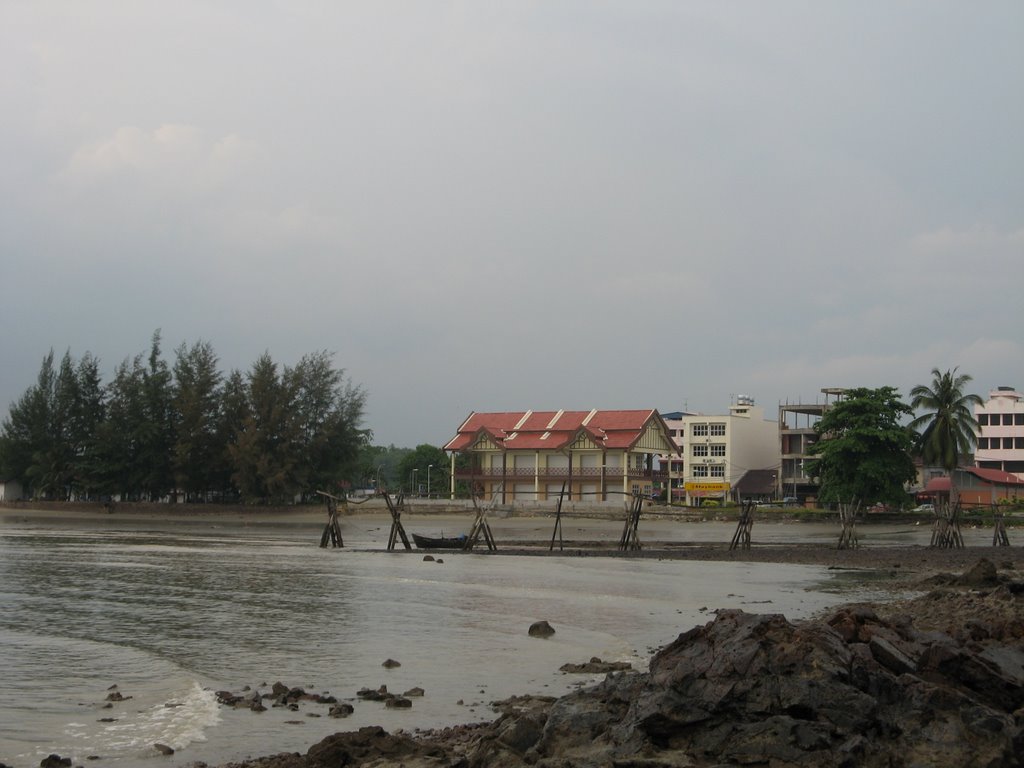
Where it used to be the shore, behind of Yok Poon Primary School

Moaning for the Lost

It was really heart broken to me to see my favorite shore in Pengerang get into this kind of state. If you browse through my very early posts about Shore behind of Yok Poon Primary School, then you will see what kind of beautiful creatures used to live there and the beautiful shore line. All these are gone now, i dont know what to say except for it is really really sad. 
(Pictures of nowadays taken by Yan Ah Kow, retrieved from facebook. Year 2012
Pictures before taken by me in Year 2008.)


1.) Where it used to be the habitat of thousands sand bubble crabs and fiddle crabs.


A reclaimed trail covered the original beautiful sand bar. How ugly, how sad.


2.) The rocky shore where i used to find anemone, shrimps and where we used to harvest clams.


Partially destroyed by the land reclamation. Are they going to turn the rocky shore into a piece of flat land?


3.) The beautiful small island which is accesible during low tide was a lively habitat full with black sea cucumbers, mudskippers and not to mentioned all kind of sea snails.


Are those cute little animals still around? i wonder what was in the mind of those workers who carried out the task of destroying such beauty.


4.) When you look from the small island towards the inner land, you used to see the coast side by side with the school.


Try to do the same thing now, you will see machines and man made land. What had we lost forever?


A video i took in year 2008, which you can see the beautiful untouched coastal line.

Thursday, April 03, 2008

Shore Behind of Yok Poon Primary School (5)


May be, i won't be able to update this blog again for months ...
i will on the road again soon and this time, i do not know when i will come back home again.


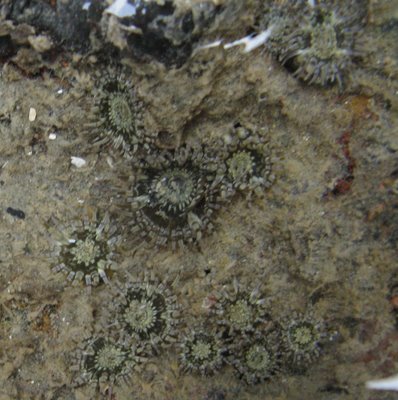
Banded bead anemones in the rock crevices.
When out of water, they retract their tentacles and look like beads of jelly.
In the pool, they extend their tentacles and filter feed.


This is a community of sand bubble crabs.
This kind of small crabs eat the coating of detritus on the sand grains.
Processed sand is discarded in little balls.
The tongue structure of the crabs is actually on their legs.


This looks like an elbow crab to me, with its relatively longer pincers.
During the talk with Dr. Dan, he shared about how crabs mate. The male organ of crab will go into the female's body. They can mate for ten days and up to 12 hours continuously for a day. The male will inject around 2 little of sperm into the female!


Barnacle is crustacean, or in simple words, the relative of crabs.
To continue the sex story, barnacles have the longest pennis for animals, relatively to its body size.
They can switch from male to female or vice versa.


Venus clams are normally found under the rocks.
When i was young, picking clams at the shore is a kind of family activity and source of extra-dishes.


Limpet is a kind of snail with the shape like a hat.
They lift their shells and crawl around the rock to graze algae.


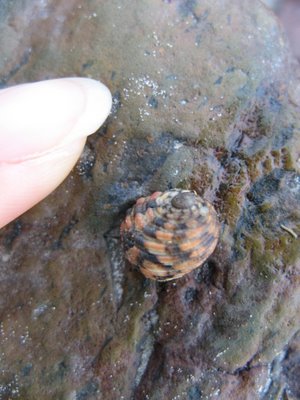
Top shells are abundant at the shore. They are a kind of snail which graze on algae.

Saturday, March 29, 2008

Shore Behind of Yok Poon Primary School (4)


i always like to explore this this small island. Most part of the island is submerge during high tide and it is only accessible during low tide. This island is right behind of the school and when i was young, during the art lesson, the teacher even asked us to sketch it.


The red tall building is a Sungai Rengit Malay Primary School. Beside it, it is Yok Poon Primary School.

This Soneratia alba mangrove tree (Malay: Perepat) is almost and icon of this small island.
Its circular leaves may be eaten raw or cooked and the ripe fruits are edible.
It is the host tree of fireflies.


i found this red color nerite particularly beautiful.

Nerite is a kind of marine snail and it has one of the strongest shell structure.


A beautiful blue hermit crab is hiding in the shell.
i used to think collecting shell at the beach is something romantic. :)
But since i become a nature guide, i realised that, shell collection is depriving hermit crabs from their houses.
At the same time, those shells selling by the shop is probably by first killing the snails first, in order to get their beautiful shells.
(Hermit crabs don't kill the snail in order to get the shells. They just used the one which is empty and suit to them.)
i remember Ria said something like: How long are you going to look at the thing if you bring it back home? 3 minutes? and then you just leave it there and eventually forgot all about it.
Then, why not do a good act to just leave the shell alone. A shell in good condition can become the house of a hermit crab and the broken shell eventually become the sand.


Onch is a kind of sea snail without a shell. Its thick skin prevent it from drying out.
It is so well camouflage with the similar skin color and texture with the rocks that, i almost step on this one.
It breathes air through its modified gills at its backside.


The left side is just a shell of an oyster while the right side is an oyster alive. i was actually surprised to find even one live oyster as the residents here are coming to the shore from time to time to harvest free seafood.
Oyster is a kind of soft body animals with 2 shells. They feed by filter the organic particles in the seawater during high tide.


These are my favorite animals at this shore.
They are colonial anemone. They are a kind of animals (not plant) with stinging cells like coral or jellyfish.
They get their food from photosynthesis of the algae living with them and filter feed organic particles in the seawater.


The name of this snail is drill.
It gets it name from its way of feeding. It can use its tongue like structure to 'drill' a hole at barnacle to feed on it.
Its hatched eggs turned into purple color and the yellow color eggs are the unhatched one.


Monday, April 09, 2007

Shore Behind of Yok Poon Primary School (3)


Finally, i bought a new camera to replace my lost one. And i was lucky enough that, it was low tide when i got back home. So, i dragged my friend to go to the shore with me. :) There were nothing much at the shore though. The tide was not low enough, so we did not see the black sea cucumber. However, we saw a tiny elbow crab and i think my friend now knows that, why we should always visit the shore with a guide! :p

i will be away for another few months, likely until September. So, it is not likely that i will have anything to upload here until then. However, i think i should still be able to do the Q&A or comment stuff. :)


Like usual, we were greeted by the Friddle Crabs near to the Sonneratia mangrove tree. Male Friddle Crab has one big pincer and one small pincer. The big pincer is so huge and heavy that it is bascially no practical function. It is used to attract female, to show that i am mascular! (In the animals world, manhood is equally important. :)


There used to be abandance of oyster around the shore area, but due to over collection, there isn't as many now. Oyster is two-parted shell softbody animals. One of their shell stick firmly on the rock. When the tide comes in, the other half of the shell will open and it started to filter feed. It filters organic particle in the sea water. So if the water is polluted, either by heavy metal such as mercury or human waste, then these toxic is very likely to remain in the body of oyster. When you eat the oyster, these things will transfer to your body!


The things which look like a hat and stick on the rock is a kind of snail called limpet. It can shape its shell to suit to the uneven surface of the rock. This snail can lift up thier shell to move. So it is not stationary.


This volcano looked creature is called barnacle. It is the close relative of crab, so it is a crustacean. Barnacle is a pest in shipping industry as it will stick at the bottom of the vessle and hence causing the additional used of the fuel to drive the now heavier ship.


This is a tube of a tube worm. The tube worm is living in the tube under the ground and the tube is made from both mucus and sand. This species of tube worm like to attach a piece of leaf to its tube. It is believed that, the leaf will help the worm to better sense the vibration and hence, predator. Some fishermen would pull out the tube or dig the worm out as fishing bait.


i flipped over a rock and saw this tiny little crab, around 1cm. It looked like just another ordinary crab to me but when i took a closer look now, it looks like an albow crab to me. Its pincers are obviously longer than other ordinary crab.


Ok, this animals become my favorite in my hometown shore. There are always there and they look beautiful! This is colonial anemone. Anemone is called "sea sunflower" in Chinese. You can see the one opened and the one closed in this picture. The open one does look like a sunflower right? The have stinging cell, so they are cnidirian like jelly fish.


We saw these two stranded jelly fish on the way back. They were likely dead or going to die...
Some jelly fish will swim up-side-down to have their tantacle facing up. This is because there are sometimes symbiotic algae staying at the tantacle. These algae will produce their food from the sun and eventually the jelly fish gets its share too.


This is a simple and basic crane used by the fishermen to upload their catch from their boat to the jetty.


The black color dots that you see were all flies! There were tonnes of them flying and stopping on the fishes left on the ground. When i asked the fisherman were these to sell at the market (i asked in my horror, although i myself don't eat) ? To my relief, he said, no, these were to sell for making pet food.

Sunday, April 16, 2006

Shore Behind of Yok Poon Primary School (3)

i don't know why. Every time when i go back home and wanted to take photos at the shore, the next thing i know when i arrived at the shore is, it rains. You can see from the picture above that, the sky was cloudy and dark. It was around 5pm and just after a very heavy rain. I was already at the shore when it rained and had to took up a shelter to wait for the rain to stop. Fortunately, the rain did stop after half and hour, so i could continue to take photos.
The buildings that you see are located at the main street. A market used to be there as well, however it was relocated to the inner area few years back.

Doesn't it interesting? A hermit crab climb onto the pencil root of the mangrove.

Oop! Distrub! A love corner. Mating nerites. Nerites are hermaphodrite (have two genders) and they have external fertilization.

This nerite is even smaller than my finger tip. If you pay a little bit of attention to your surroundings, then you will see a lot of interesting things that you never even notice before.

This pool has many opened up banded bead anemone. They look like small flowers. When you go to the shore, look into the pool to see many interesting life!

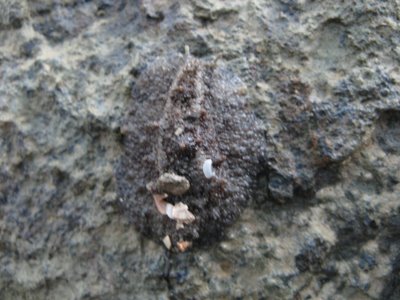
Can you see the sea slug? It is a snail without a shell. It has thick skin to prevents it to dry out. It has similar color with the rock, so most of the time it will be overlooked. Camourflage (same shape or color to blend in surroundings) is the common way for animals to protect themselves.


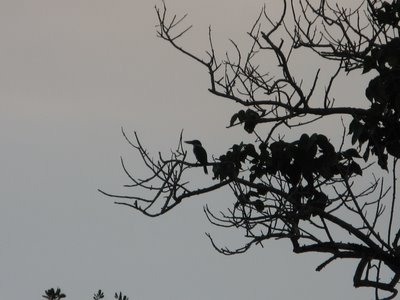
Well, this is actually a collared kingfisher. It is blue in color. It hunts for small crabs, prawns and fishes during low tide. It is normally in pairs.

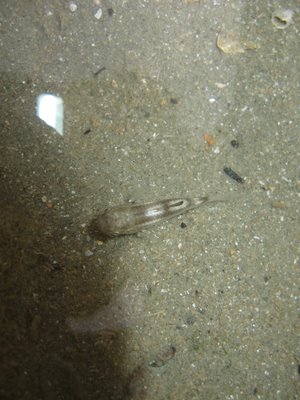
Gobbies feed on smaller animal. Some of them are toxin and some of them are staying with shrimp in a symbiosis relationship (both sides gain benefit).

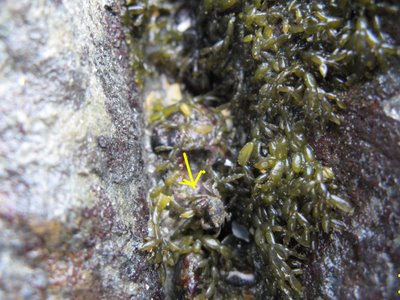
A tiny little crab hide itself in the sea weed. It would grow up and many be end up on your plate.

Fruit of the nipah palm or atap chee, what we normally find in our ais-kacing. This one has obviously floated in the sea for quite a long time until it becomes black.

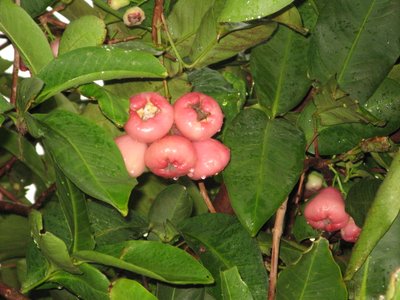
This is rose apple or in Malay language, jambu air. It tastes slightly sweet and juicy. It is seasonal and home grow to many of the household.